
Social media marketing has played a vital role in the success of many veterinary businesses, with clinics, referral centres and suppliers all using social to build an audience and engage with customers.
But with constant updates, new platforms, algorithm changes, and more, dipping your toes – or paws – into social marketing isn’t as easy as it once was.
Here, we take a look at the benefits of organic and paid social media marketing and how you can use them for your veterinary business. Read on for tips on achieving an impact on the channels that matter most to you.
What is the difference between paid and organic social?
Simply put, organic social refers to any social post, posted for ‘free’ without paying the platform to amplify reach, whereas paid social refers to any ad you publish or boosted post you pay for.
Organic social posts include non-paid for stories, posts, reels, TikTok’s and more, while paid social content includes sponsored posts, ads, boosted posts, and more.
Why you need both, and how they complement each other
Sounds simple, right? Well, that part is.
You’d be forgiven for thinking that if you’re running paid social ads, you don’t need organic socials, and vice versa.
The truth is, without a strong organic social presence for your veterinary brand, you’re preventing your paid social ads from achieving their full potential.
And, without paid social, you’re missing the additional brand awareness, sales and leads that paid social can help you achieve.
Social as a trust signal
Organic social media is especially important for less established brands and businesses.
For instance, a pet owner could see an on Facebook for a local veterinary practice. They like the look and messaging of the ad, so they click on the brand’s Facebook page to learn more about the clinic.
But there’s nothing to see – the practice hasn’t posted in some time and it has only a small number of followers. The page feels almost abandoned and so it could make the pet owner hesitant to use the service, or even to find out more.
This isn’t an uncommon thing for users to do either. Think about your own behaviour when researching a product or service, what kind of trust signals do you look for?
Quality over quantity
Organic social isn’t only about posting consistently, or having tons of followers.
The most successful organic social media channels are the ones that priorities the quality of posts.
Publish interesting, useful and entertaining content and the followers will… well, they’ll start to follow.
Take that same scenario, but picture the Facebook page with high quality content – case studies of patients they’ve treated, meet the team, positive client feedback – that has been posted regularly.
It completely changes your perception of the brand and immediately instils greater trust.
Extending your reach
One of the many strengths of running paid social campaigns is that they allow you to amplify your social reach without relying on the platforms tricky and ever-changing algorithms.
They can also help to drive essential sales and leads for your veterinary business, whether you are targeting consumers or other businesses in the sector.

What social media platforms should you use?
What you’re offering, or trying to sell, will inform your paid and organic social media strategy and the platforms you use to deliver it. Here’s a breakdown of social media split by age, courtesy of Sprout Social.
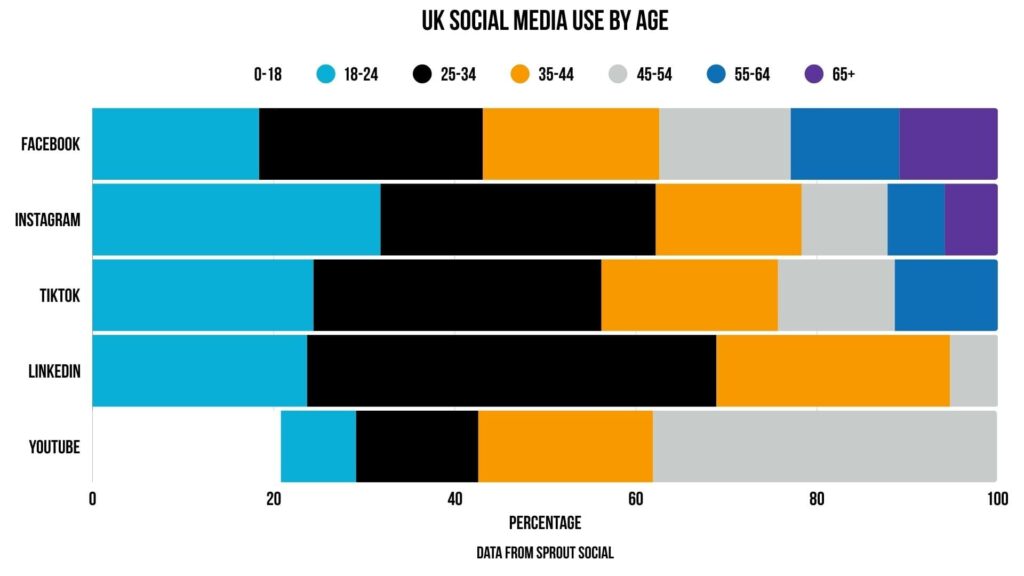
That, of course, isn’t the only factor you should take into consideration when deciding which social platforms to focus on.
For example, if you’re not able to commit enough time to creating videos, you’ll probably want to focus your efforts somewhere other than TikTok.
If you lack the budget to outsource your social media management, or the time to manage them yourself, you’ll need to be selective and only use the ones that work for you.
TOP TIP: Having one social media channel that is regularly updated with quality content is much more valuable to your business than multiple channels with sporadic posts.
Tools and resources for social media
There are plenty of tools out there that can help you manage your organic socials and your paid campaigns.
Firstly, there are organic social management tools, designed to help you schedule posts in advance, write posts and more. These include Hootsuite, Sprout Social and Buffer.
For analysing post performance, you can use in-platform analytics, or the analytics provided by your social management tool.
For paid social, the key tools to create and manage ads will be Facebook Ads Manager, LinkedIn campaign manager, TikTok Ads Manager and more.
While you can use the relevant social platforms analytics to view the performance of your ads, we recommend linking your ads to Google Analytics.
This will enable you to track the behaviour of users once they click through to your site.
You can check out our recommendations for the best free PR and Social Media tools here.

How social communities can support your organic posts and paid social ads
Social communities are much stronger than you realise. Not just when it comes to boosting engagement – they can also be positive voices in a world of negativity.
These brand ambassadors can help reinforce your messages, and occasionally, opt to defend you against those who may have negative opinions about your brand.
Not only that, each comment or like you receive improves your organic post reach and helps to boost performance for your ads.
Think about your own online behaviour. Reviews, whether positive or negative, affect your purchase making decisions and that goes for your own consumers too.
That’s why building a strong, valued community that will vouch for your product or service can heavily influence whether people learn more about your product or even buy it.
Look at these examples below of brands and businesses that have created a strong community, and the impact it has on their posts and ads.
Davies Veterinary Specialists

As you can see from the example above, it only takes one user to support your cause and act as an honest and trustworthy voice to make a significant difference in post performance.
Passenger Clothing

This post has received lots of likes and comments, which as mentioned above, increases post reach.
Every social platform wants its users to be scrolling for as long as possible, and uses engagement, such as comments, likes and video views, to serve its users with the most engaging and relevant posts.
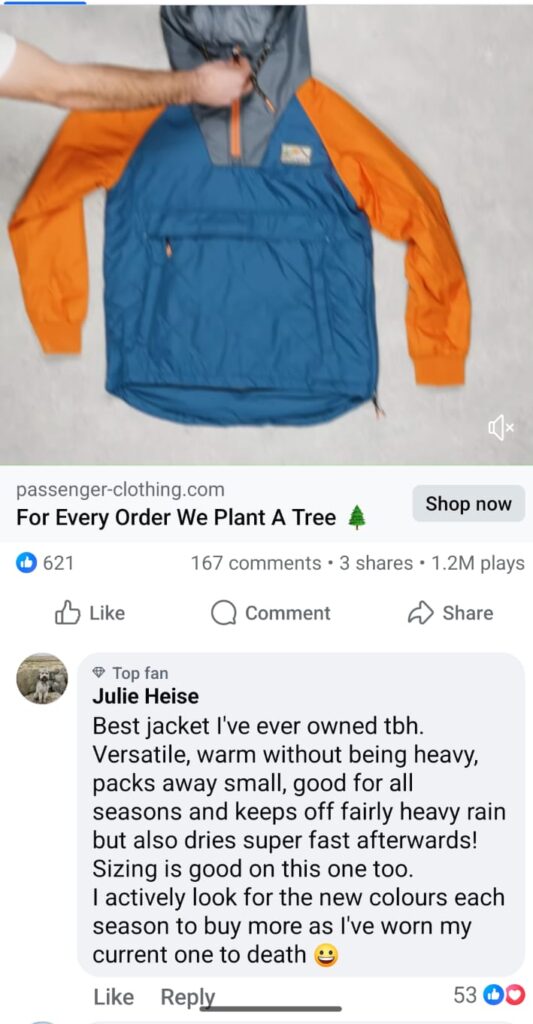
This quick review and comment from Passenger’s ‘top fan’, Julie, tells its readers two things: they’re a trustworthy brand, and their products are high quality.
Most people will only take the time to write reviews for either extremely positive or overwhelmingly negative experiences, which is why you’ll rarely see a two- or three-star review for a product.
Every product review or client testimonial is so powerful, and its impact can’t be overstated.
Rheal

Here, you can see just how many comments, shares and likes Rheal’s ads have received, and to reiterate, this is down to building a strong and engaged community.
It also helps to have an excellent product, of course!

Why strong SEO and PR are important for social media
For some brands, SEO and PR can be an afterthought, but utilising these alongside social media can have an enormous impact on your overall results and performance.
It’s extremely common for users to view your product, or brand, and not click on the ad immediately.
Purchasing any product or service, takes much consideration, from viewing alternative options to reading reviews and searching for different prices.
Having a website that has been optimised, so it’s easily found when products or services are searched, can have a massive impact on sales and performance.

Further to this, consumers care about a brand’s ethics, and what they stand for more than ever before.
Having positive stories about your brand covered by third party websites, such as charity work, could be the deciding factor on whether people choose your service or product.

Building a strong organic and paid social strategy
Running ads on any social platform without a proper strategy in place is as useful as carrying water in a sieve.
You might get some results, but you’ll be wasting your time and money.
The same goes for organic socials.
Without an understanding of the platform you’re posting on, or what it is you’re trying to accomplish, you’ll be wasting your time.
Of course, our social media team can create and manage organic and paid social strategies for you, but here are some pointers to get you started:
Define clear objects and name your key goals
Do you want to drive leads? Are you looking to achieve greater brand awareness? Or are you completely focused on sales? Set your goals before you create any content.
Set KPIs to measure success
Cost per click, impressions and conversions are key metrics that you should monitor to help you understand what success looks like.
Know your audience!
Understand your target audience demographics and behaviours. It will help you to create content and ads that your audience is more likely to engage with.
Test, test and more testing
Using A/B testing, or even testing several types of creatives and copy in your posts and ads, is essential to understanding what resonates with your target audience. It will enable you to improve performance over time.
Strong creatives
The creative assets you use for your organic posts and your paid ads are key to strong performance. Think about what your audience will respond to and create content that catches the eye.
User Generated Content
Encourage your followers to generate UGC and use this content in your social posts and your paid ads. UGC acts like a third party endorsement and builds trust with your audience.
Conclusion
While both paid and organic social media are invaluable, they become even more powerful when used together, with a strategy in place for both.
You’ll find paid social media can be more expensive, but less time consuming than organic social media.
You can reach people faster with paid social media, but you’ll build stronger connections and communities with organic social media.
And don’t forget, we’re here to help with all things social media. Drop us an email to find out more.
