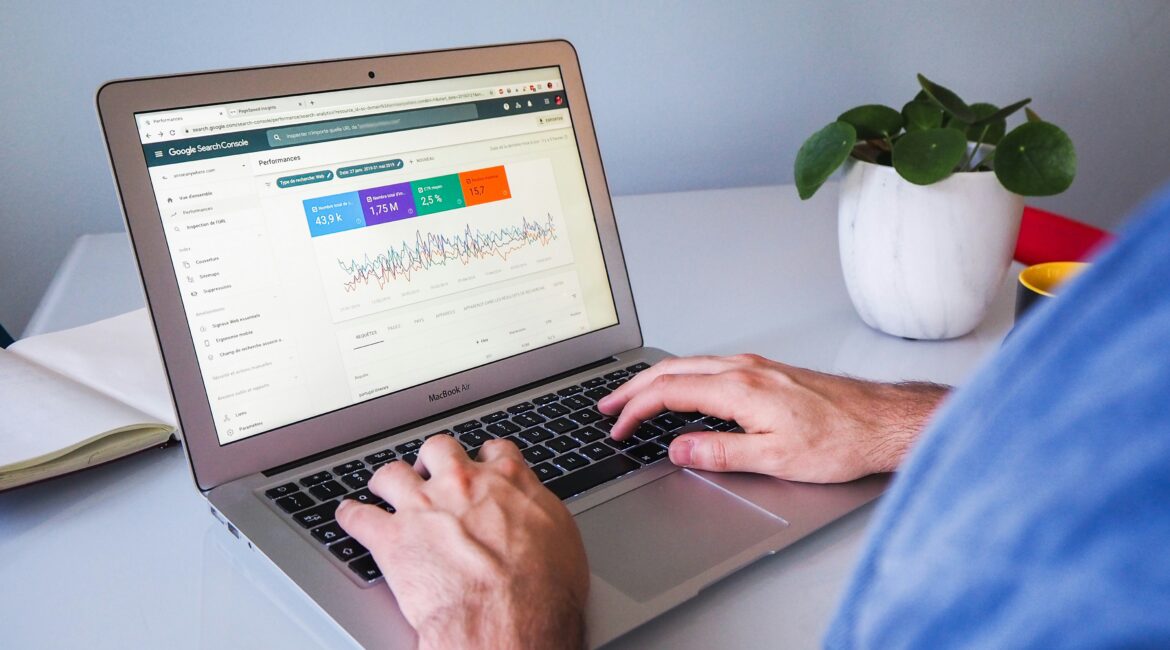
For years, Google Search Console has been the first place SEOs turn to understand what is driving organic visibility for a website.
Which queries are bringing people in? Which pages are getting impressions but not enough clicks? Where are there opportunities to improve?
Now, Google is expanding that insight beyond websites.
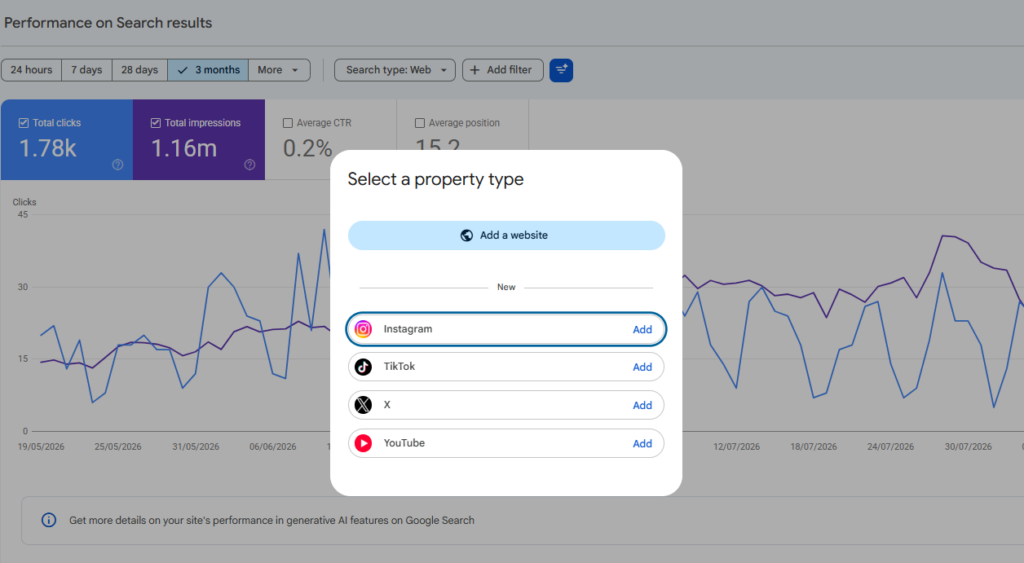
In July 2026, Google introduced platform properties in Search Console, allowing creators, publishers, social media teams and SEOs to see how content published on YouTube, Instagram, TikTok and X is discovered through Google Search and Discover. The rollout became globally available later that month.
The interesting part is that this extends Search Console beyond the website itself.
It’s yet another sign that SEO is becoming less about a website in isolation and more about how an entire brand is discovered across channels.
What are Search Console platform properties?
The new platform properties allow you to connect an eligible social or video account to Search Console and see how its content performs in Google.
That includes all too familiar Search Console metrics such as clicks and impressions, alongside the specific posts, videos and search queries contributing to that performance. Google also provides an Insights report showing recent traffic trends, top-performing content and how audiences are discovering an account.
The important distinction here is that this is not telling you how well a TikTok video performed inside TikTok, or how many views a YouTube video generated.
Instead, it shows what happens when someone discovers that content through Google.
A video could be performing modestly within a social platform but still generate meaningful visibility through Google. Equally, a post that looks successful from a social media perspective might not be attracting much search visibility at all.
Until now, those two pictures have largely sat in separate reports, but now Search Console is starting to join them up.
Why does this matter for SEO?
In an agency, SEO, social, content and PR can often sit with different teams, each with their own objectives and reporting. But that isn’t necessarily how people discover brands.
Someone might see a TikTok video, Google the brand, watch a YouTube video, read a website article and then eventually make an enquiry.
Google’s new platform properties don’t solve attribution across the entire customer journey, but it does give us another useful piece of the puzzle and importantly, it gives SEO teams access to data which can be fed back into wider social and content strategy.
Social search isn’t new, but Google measuring it is
There has been plenty of discussion over the last few years about whether people, particularly younger audiences, are changing where they search.
It would be a mistake to interpret this as “Google is dead” and social platforms have taken over.
The reality is a little more complicated.
Other research suggests that younger consumers are increasingly using social platforms alongside traditional search. For example, a US report by Search Engine Land found that among 18 to 27-year-olds, Instagram and TikTok were more frequently selected than Google for discovering new products.
Adobe’s latest report into TikTok usage indicates that nearly one in two consumers (49%) use TikTok as a search engine.
The UK data tells a similar story. Ofcom’s 2025 Online Nation research found that adults in the UK spend an average of four and a half hours online each day, with YouTube reaching 94% of adults.
The point isn’t that social has replaced search.
It’s that search behaviour is becoming increasingly fragmented across platforms, and Google’s platform properties feature acknowledges that reality.

What should brands actually do with this data?
- Look for topics, not just individual posts
Don’t just identify your most clicked TikTok or YouTube video and call it a day.
Look at the queries behind that visibility.
Are there recurring themes? Are certain questions appearing across several pieces of content? Are there gaps where people are searching for answers but you have limited content available?
You can think of it as keyword research beyond the website.
For more on how you might begin to approach this, see our guide to keyword research for SEO.
- Find content that deserves a second chance
Look for older videos and posts that are beginning to regain search traction.
If something is picking up search visibility again, that could be a good reason to refresh it, update the accompanying copy, create a follow-up or promote it through another channel.
It also challenges the idea that social content has a shelf life of a few days.
If Google is still sending people to it months later, it clearly has some ongoing value and relevance to seasonality.
- Connect social insights with website SEO
This is probably where the data becomes most useful for an established SEO programme.
Suppose a series of TikTok videos starts attracting searches around a specific question.
That might point towards a new website landing page, FAQ, blog article or service page opportunity.
The opposite can work too.
If your website data shows increasing search demand around a topic, that insight can inform the next batch of social or video content.
Instead, the more useful question is whether the topic matters to your audience.
- Measure the brand, not just the channel
At R&Co, we already talk about the importance of bringing PR, SEO and social together. Our PR, SEO and social media marketing tips for 2026 covered the growing importance of social search and creating content that is designed for the platform it appears on.
Platform properties give teams another way to measure that joined-up approach.
A brand doesn’t stop existing when someone leaves Google and opens TikTok.
And it doesn’t stop being discoverable when someone encounters it through YouTube rather than a website.
What does this mean for an SEO strategy?
This latest update means we should become more interested in what happens outside of the website and the strongest SEO strategies are already moving in this direction.
We’re already seeing SEO overlap with brand authority, PR, digital PR, video, social content, first-hand experience and AI search visibility.
These aren’t separate activities anymore. They can all influence how someone discovers and evaluates a brand.
Our recent guide to increasing AI search visibility for professional services further reinforces that point: that visibility increasingly depends on having credible, useful and consistent brand information beyond a single webpage.
The challenge is working out how these different channels influence each other, and where SEO can use those insights to inform the wider strategy.
Platform properties won’t give us the full picture, but they give SEOs another useful source of data.
Do you need some help navigating Search Console and generating visibility in organic search? Our SEO services can help. Contact our team to arrange a consultation.